Definition
The classifications of physics are the major branches into which physics is divided, based on the type of physical phenomena being studied.
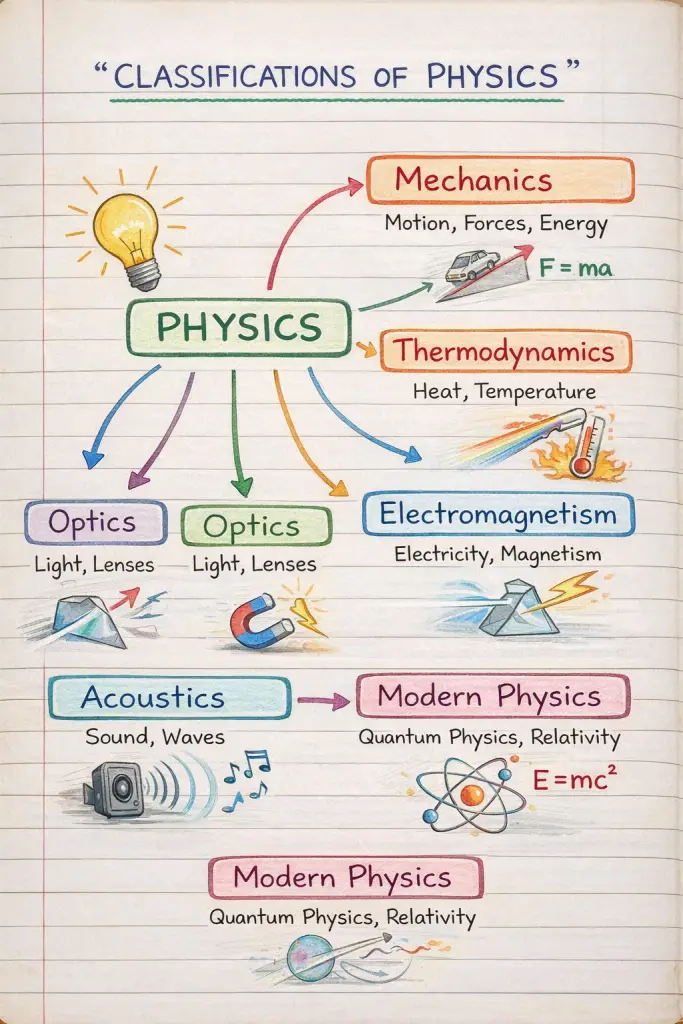
Explanation
Physics is a broad subject, so it is grouped into different branches to make the study easier and more organised. Each branch focuses on a particular aspect of nature, such as motion, heat, electricity, light, or the structure of matter. These classifications help students and scientists study physical laws in a systematic way.
Imagine
Think of physics as a big tree 🌳. The trunk is physics itself, while the branches represent different areas like mechanics, electricity, optics, and modern physics. Each branch studies a specific part of nature.
In simple terms
Classifications of physics are the different areas of physics, each studying a particular kind of physical behaviour.
Formula
There is no single formula for the classification of physics. Each branch has its own laws and formulas.
Key Points
- Physics is divided to simplify learning and research
- Each branch studies a specific type of physical phenomenon
- The branches are closely related to one another
- Classical physics deals with everyday phenomena
- Modern physics deals with atomic and subatomic phenomena
Main Classifications of Physics
- Mechanics – Study of motion, force, work, and energy
- Thermal Physics (Heat) – Study of heat, temperature, and energy transfer
- Waves and Sound – Study of vibrations and wave motion
- Optics (Light) – Study of light and its behaviour
- Electricity and Magnetism – Study of electric charges, currents, and magnetic fields
- Atomic Physics – Study of atoms and their structure
- Nuclear Physics – Study of the nucleus of atoms
- Quantum Physics – Study of matter and energy at very small scales
- Relativity – Study of space, time, and high-speed motion
Examples
- Motion of a car – Mechanics
- Heating water on a stove – Thermal physics
- Reflection in a mirror – Optics
- Electric fan working – Electricity
- Radioactive decay – Nuclear physics
Applications
- 🚗 Vehicle and machine design
- 🔥 Heating and cooling systems
- 💡 Lighting and optical devices
- ⚡ Power generation and transmission
- 🧬 Medical imaging and radiation therapy
Question
Why is physics divided into different branches?
Answer
Physics is divided into branches to make the study of natural phenomena easier, more organised, and more detailed.
Solved Problem
Question:
Which branch of physics explains the motion of planets around the Sun?
Answer:
The motion of planets around the Sun is explained by mechanics, specifically celestial mechanics, which deals with the motion of heavenly bodies.