0:00
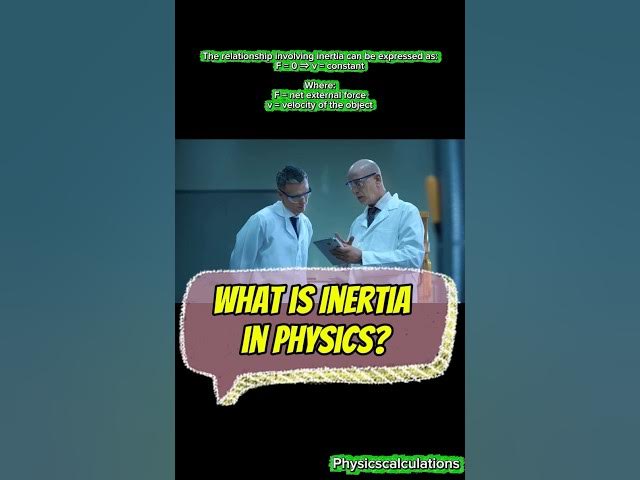
What is inertia in physics? Inertia is
0:02
the property of a body that resists any
0:05
change in its state of rest or uniform
0:08
motion. Inertia explains why an object
0:11
remains at rest or continues moving at a
0:14
constant velocity unless acted upon by
0:17
an external force. It is closely related
0:20
to mass. The greater the mass of an
0:22
object, the greater its inertia. There
0:25
are different forms of inertia including
0:27
inertia of rest, inertia of motion, and
0:30
inertia of direction. Inertia is the
0:32
reason objects do not start moving,
0:35
stop, or change direction on their own.
0:38
Imagine sitting in a car. When the car
0:40
suddenly stops, your body moves forward.
0:44
This happens because your body tends to
0:46
continue in its state of motion due to
0:48
inertia. Examples: A book remaining at
0:51
rest on a table. Passengers moving
0:54
forward when a vehicle stops suddenly. A
0:56
moving ball continuing to roll until
0:59
friction stops it. Difficulty in pushing
1:01
a heavy object compared to a light one.
1:04
Objects resisting changes in motion.