Up next in 10

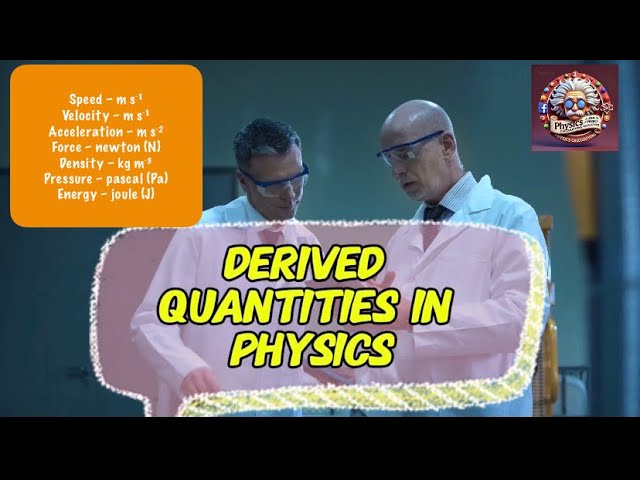
Derived Quantities in Physics
Derived quantities are physical quantities that are obtained by combining two or more fundamental quantities using mathematical relationships.
Show More Show Less View Video Transcript
0:00
Derived quantities in physics.
0:02
Definition. Derived quantities are
0:04
physical quantities that are obtained by
0:07
combining two or more fundamental
0:09
quantities using mathematical
0:11
relationships. Derived quantities depend
0:14
on fundamental quantities such as
0:16
length, mass, and time. They are not
0:19
measured directly. Instead, they are
0:21
calculated using formulas. For example,
0:25
speed is obtained by dividing distance
0:28
by time. both of which are fundamental
0:30
quantities. Imagine baking a cake.
0:33
Flour, sugar and eggs are your basic
0:36
ingredients. Fundamental quantities. The
0:39
cake you produce by mixing them in the
0:41
right way is like a derived quantity
0:43
created from the basics. Derived
0:46
quantities are quantities formed by
0:48
combining basic measurements. Derived
0:51
quantities are defined using formulas
0:53
made from fundamental quantities.
0:56
Examples: Speed equals distance/ time.
0:59
Density equals mass. Volume. Force
1:03
equals mass time acceleration. Key
1:05
points. Derived quantities depend on
1:08
fundamental quantities. They're
1:10
calculated not measured directly. Each
1:13
has a derived SI unit. They describe
1:15
more complex physical phenomena. They
1:18
are widely used in physics calculations.
1:21
Common derived quantities and their SI
1:23
units. Speed MSY, velocity MSY,
1:28
Acceleration MS 2, Force Newton on
1:33
Density KGM cubed, Pressure Pascal P,
1:38
Energy, Jewel J. Examples: Speed of a
1:42
moving car, density of a metal block,
1:45
Force applied to push an object,
1:47
pressure in a gas cylinder, energy used
1:49
by an electric appliance. Applications:
1:52
Motion analysis in transportation,
1:55
engineering and construction design,
1:58
electrical and mechanical systems,
2:00
scientific and laboratory calculations,
2:03
industrial process control. Question,
2:06
how are derived quantities different
2:08
from fundamental quantities? Answer:
2:11
Derived quantities are obtained by
2:14
combining fundamental quantities
2:16
mathematically while fundamental
2:18
quantities are independent and measured
2:20
directly. Solved problem question. A car
2:23
travels a distance of 100 m in 5S.
2:27
Calculate its speed. Answer given.
2:30
Distance equals 100 m. Time equals 5s.
2:35
Speed equals distance/ time. Speed
2:38
equals 100s. Speed equals 20 msy.
#Science
#Physics