Up next in 10

Newton’s second law of motion
Show More Show Less View Video Transcript
0:00
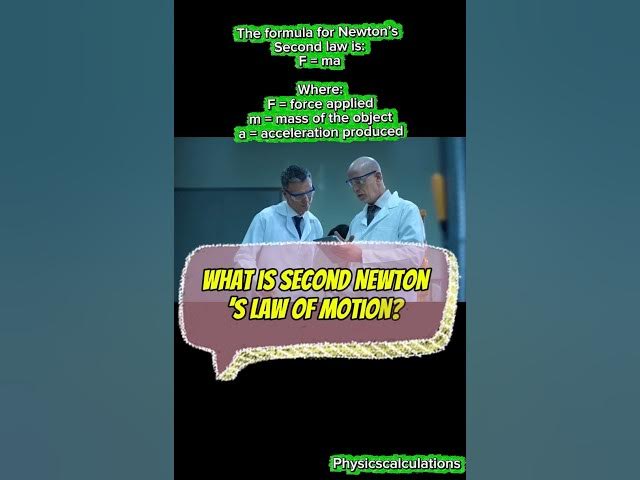
What is second Newton's law of motion?
0:02
Second Newton's law of motion states
0:04
that the rate of change of momentum of
0:07
an object is directly proportional to
0:09
the applied force and occurs in the
0:11
direction of the force. This law
0:13
explains how the motion of an object
0:16
changes when a force acts on it. It
0:19
shows that the greater the force
0:20
applied, the greater the acceleration
0:22
produced. It also shows that heavier
0:25
objects require more force to achieve
0:28
the same acceleration as lighter
0:30
objects. The law can also be understood
0:33
in terms of momentum where force causes
0:35
a change in momentum over time. Second
0:38
Newton's law is very important in
0:41
analyzing motion because it connects
0:43
force, mass, and acceleration in a
0:45
simple relationship. Imagine pushing two
0:48
carts, one empty and one loaded. The
0:51
empty cart accelerates quickly with a
0:54
small force while the loaded cart
0:56
requires more force to achieve the same
0:58
acceleration. Examples: a car
1:00
accelerating when the accelerator is
1:03
pressed. Pushing a light object versus a
1:05
heavy object. A football moving faster
1:08
when kicked harder. A truck requiring
1:10
more force to accelerate than a bicycle.
1:13
Objects speeding up when force is
1:15
applied.