Up next in 10

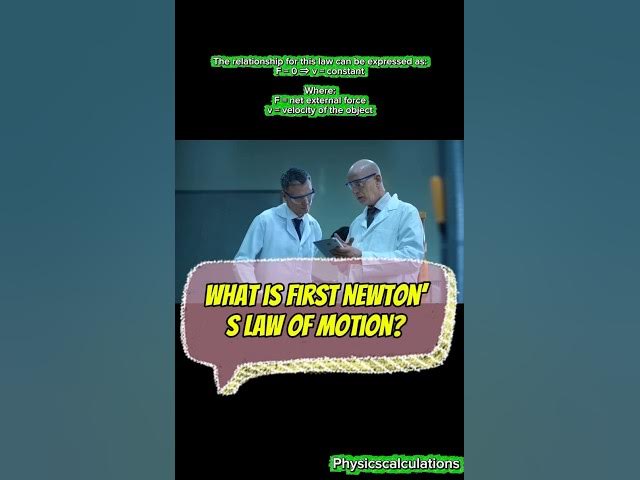
Newton’s first law of motion
Show More Show Less View Video Transcript
0:00
What is first Newton's law of motion?
0:02
First Newton's law of motion states that
0:04
an object will remain at rest or
0:07
continue to move with constant velocity
0:09
in a straight line unless acted upon by
0:12
an external force. This law is also
0:15
known as the law of inertia. It explains
0:18
that objects resist any change in their
0:21
state of motion. If no external force
0:24
acts on an object, it will not start
0:26
moving, stop moving, or change
0:28
direction. Inertia depends on the mass
0:31
of the object, the greater the mass, the
0:33
greater the resistance to changes in
0:36
motion. This law helps explain why
0:38
objects behave the way they do when
0:40
forces are applied or removed. Imagine a
0:43
book resting on a table. It will remain
0:46
there unless someone pushes it.
0:48
Similarly, if a ball is rolling on a
0:51
smooth surface, it will keep moving
0:53
unless friction or another force stops
0:55
it. Examples: A book staying at rest on
0:58
a table. A moving car continuing forward
1:01
until brakes are applied. Passengers
1:04
leaning forward when a moving vehicle
1:06
suddenly stops. A ball continuing to
1:09
roll until friction slows it down.
1:11
Objects resisting changes in their
1:13
motion.