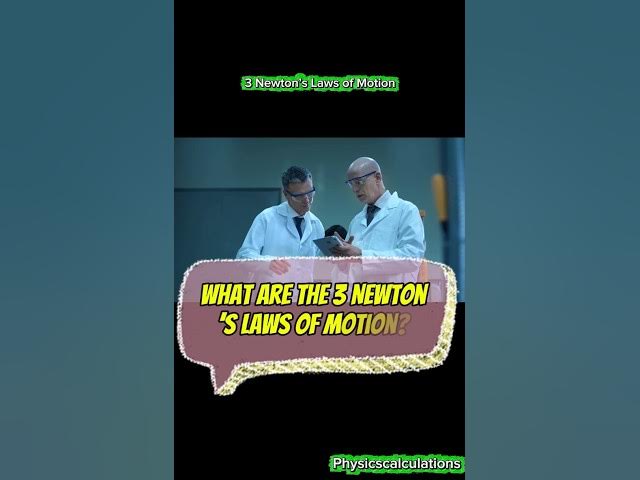
Up next in 10

Newton’s Laws of Motion
Show More Show Less View Video Transcript
0:00
What are the three Newton's laws of
0:02
motion? Newton's laws of motion are
0:04
three fundamental laws that describe how
0:07
objects move and how forces act on them.
0:10
Newton's laws explain the relationship
0:12
between force, mass, and motion.
0:15
They are the foundation of classical
0:17
mechanics and help us understand
0:19
everyday movements as well as complex
0:22
physical systems. First law, law of
0:24
inertia. An object remains at rest or
0:27
continues to move with constant velocity
0:30
in a straight line unless acted upon by
0:32
an external force. Second law, the rate
0:35
of change of momentum of an object is
0:38
directly proportional to the applied
0:40
force and occurs in the direction of the
0:42
force.
0:43
In simple terms, force equals mass times
0:46
acceleration. Third law, for every
0:49
action, there is an equal and opposite
0:52
reaction. These laws explain how objects
0:54
start moving, change motion, and
0:57
interact with other objects. Imagine
1:00
pushing a heavy box, it resists motion
1:02
at first, inertia, moves when enough
1:04
force is applied, second law, and pushes
1:07
back against you with equal force, third
1:09
law. Examples, a book remaining at rest
1:12
on a table, first law, a car
1:14
accelerating when force is applied,
1:16
second law, recoil of a gun when fired,
1:19
third law, walking, where the ground
1:22
pushes you forward, rocket propulsion
1:24
due to action and reaction forces.